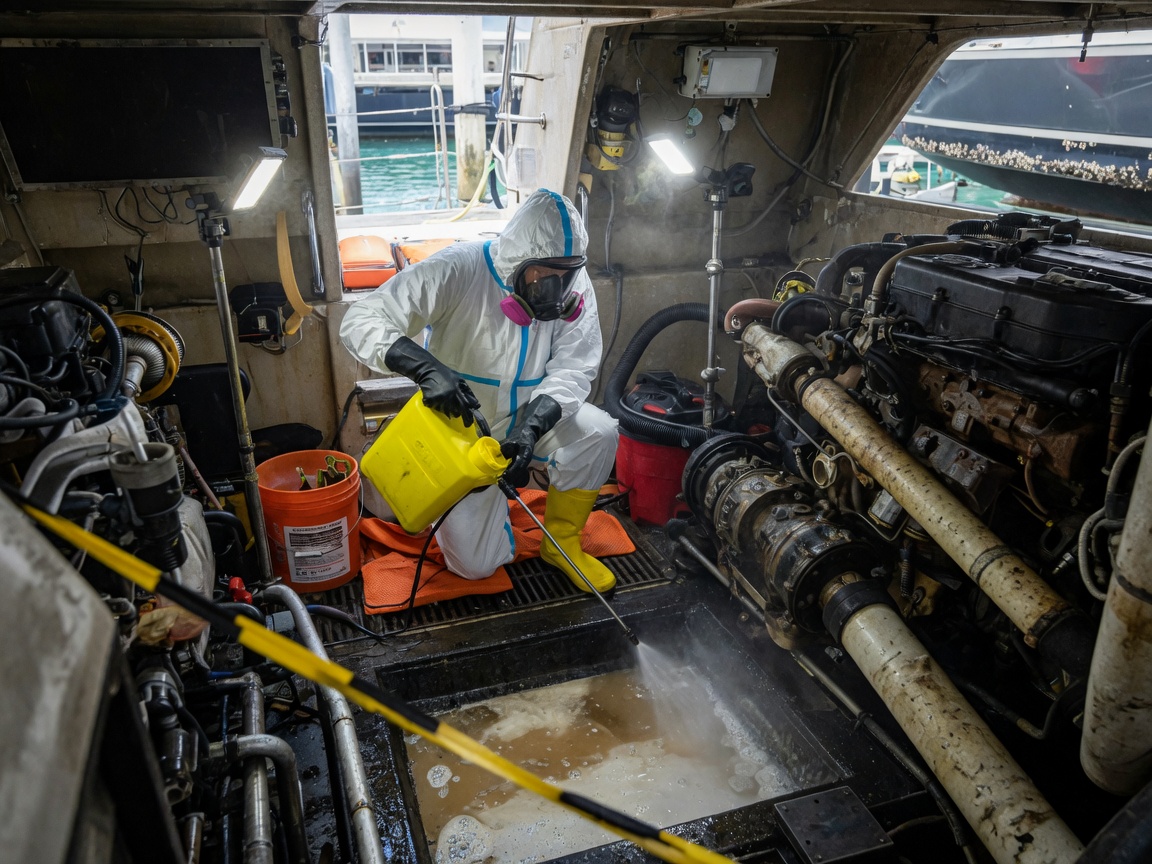
Fort Lauderdale's tropical monsoon climate brings heavy summer rains and high humidity that trap moisture in boat bilges and engine rooms, especially on vessels moored year-round in Las Olas Isles or Downtown Fort Lauderdale marinas. Salt air and limited airflow accelerate mold on stringers, wiring harnesses and bilge pump housings. Technicians must disassemble access panels and use moisture meters to locate hidden colonies behind fuel lines without spreading spores into living spaces.
Older fiberglass hulls common in Rio Vista and Coral Ridge often have factory limber holes that clog with debris, creating standing water pockets that feed mold back into the engine compartment. Remediation requires HEPA vacuuming followed by antimicrobial application rated for marine use, then drying with commercial dehumidifiers tied into shore power. Boats stored near the Stranahan House or along the Tarpon River face extra challenges from tidal surges that push contaminated water higher into the bilge during wet season.
Engine room decontamination also addresses secondary growth on exhaust manifolds and raw water cooling hoses, where heat and condensation create ideal conditions. Crews isolate the area with plastic sheeting before treatment to protect nearby electrical panels and prevent cross-contamination to adjacent yachts in tight Broward County slips. Final clearance testing confirms spore counts return to outdoor baseline levels before the vessel is returned to service.
Technician insight
In Fort Lauderdale, the thing that catches most people out with Bilge & Engine Room Decontamination is how tidal movement around Victoria Park and Las Olas Isles keeps pushing salt water back into limber holes even after initial drying, so untreated boats develop new colonies within weeks during the wet season.
Recurring Mold in Engine Room After Summer Rains
A 42-foot sportfisher in Rio Vista developed musty odors after weeks of afternoon thunderstorms. Inspection found mold behind the main engine and in clogged limber holes near the fuel tank. Crews isolated the compartment, removed growth from stringers and cooling lines, applied treatment, and ran dehumidifiers tied to shore power. Clearance testing passed and the vessel returned to its slip without odor return during the remaining wet season.
Bilge & Engine Room Decontamination Services We Offer
✓Bilge Compartment Mold Removal
Removes visible and hidden mold colonies from stringers, limber holes and pump sumps on boats docked in Fort Lauderdale's humid marinas.
✓Engine Room Ventilation Cleaning
Cleans and treats intake and exhaust vents that circulate moist air through engine compartments in Las Olas Isles and Victoria Park vessels.
✓Raw Water System Decontamination
Treats mold growth inside cooling lines and strainers that trap water and organic matter on boats in Broward County waterways.
✓Fuel Tank Area Mold Treatment
Addresses mold around tank tops and fill lines where condensation collects on vessels moored near Pompano Beach or Hollywood.
✓Bilge Pump Housing Restoration
Cleans and sanitizes pump assemblies and float switches that become mold reservoirs after repeated flooding events in Rio Vista.
Bilge & Engine Room Decontamination Cost in Fort Lauderdale, FL
| Service | Typical Range | What Affects It |
|---|---|---|
| Small powerboat bilge decontamination | $450–$850 | Depends on compartment access and whether engine room is included |
| Sailboat engine room treatment | $650–$1,200 | Higher when raw water lines and exhaust areas require extra attention |
| Yacht bilge and pump system cleaning | $900–$1,800 | Moves with number of separate compartments and tidal water intrusion |
| Follow-up drying and clearance testing | $250–$400 | Required after heavy summer rains in areas like Tarpon River |
Ranges are typical for Fort Lauderdale, FL and confirmed with an exact written quote before any work starts.
How it works
- 1
Initial Inspection
Technicians board the vessel in Fort Lauderdale and use moisture meters plus borescopes to map mold extent in bilges and engine spaces.
- 2
Containment Setup
Plastic barriers and negative air machines isolate the work area to keep spores from migrating to cabins or neighboring boats.
- 3
Physical Removal
HEPA vacuuming and manual scraping clear growth from surfaces, followed by disposal of contaminated materials per local marine waste rules.
- 4
Antimicrobial Application
Marine-safe agents are applied to treated areas, then commercial dehumidifiers dry the spaces before reassembly.
- 5
Clearance Testing
Air sampling confirms mold levels match outdoor baselines before the boat returns to service in Broward County waters.
Pricing
Pricing varies by boat size, access difficulty and extent of hidden growth; most jobs in Fort Lauderdale fall in the mid-hundreds to low-thousands range.