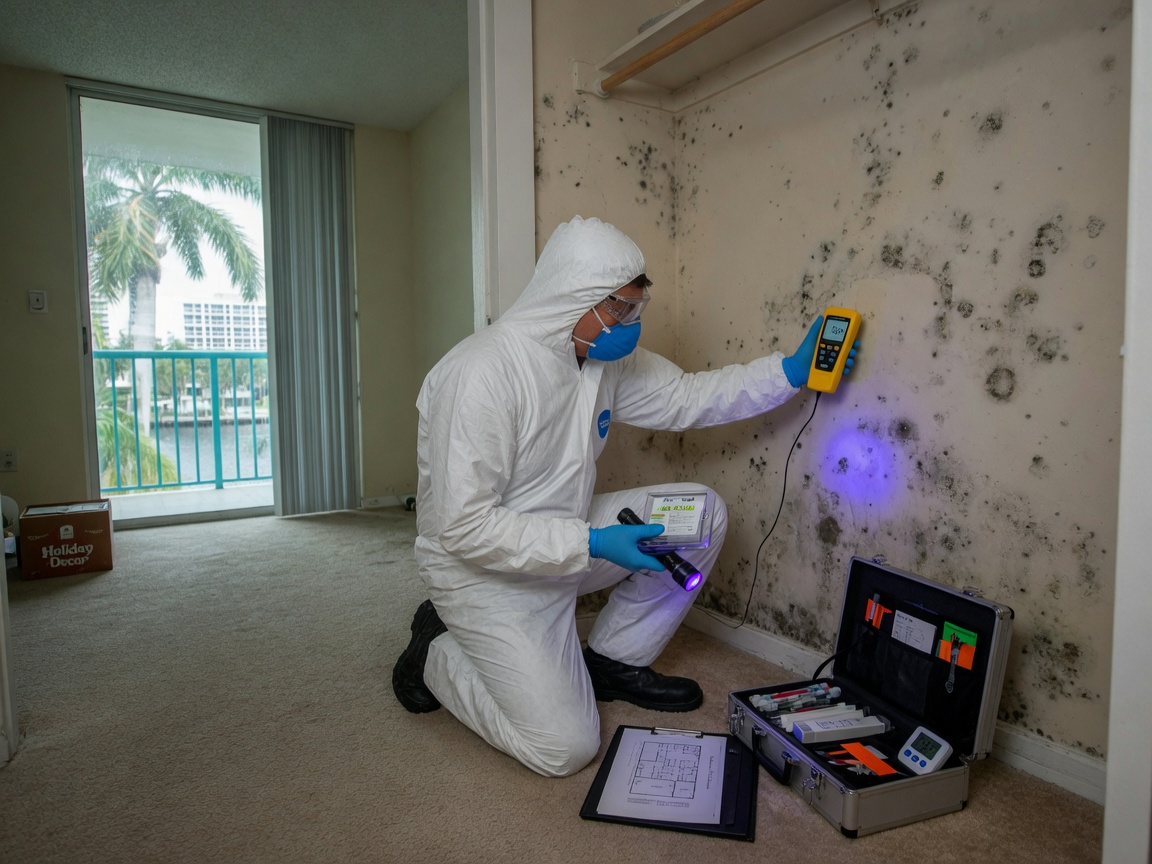
Fort Lauderdale’s tropical monsoon climate brings heavy summer rains that trap moisture inside fiberglass hulls and teak interiors, especially on vessels kept year-round at docks along the Intracoastal near Las Olas Boulevard or in Tarpon River slips. Salt air and constant humidity allow mold to colonize behind bulkheads and under floorboards long before owners notice musty odors. Inspections here require moisture meters calibrated for marine laminates plus borescopes to reach stringers and chain-plate areas that stay damp even during the drier winter months.
Older boats common in Victoria Park and Rio Vista marinas often have plywood cores and original gelcoat that delaminate after repeated flooding from afternoon thunderstorms. These materials hold water differently than modern composites, so inspectors check for soft spots with a systematic grid pattern rather than random probing. Failing to map temperature differentials across the deck can miss active colonies growing toward the engine compartment or forward cabin.
Yachts berthed near Fort Lauderdale Beach or Coral Ridge face additional challenges from wind-driven spray that enters through hatches left slightly open. Inspection protocols include documenting every reading with photos tied to specific compartments so owners can see exactly where relative humidity exceeds 60 percent. This level of detail prevents unnecessary removal of cabinetry while still catching growth before it migrates into the bilge or electrical panels.
Technician insight
In Fort Lauderdale the thing that catches most people out with Mold Inspection is how quickly afternoon thunderstorms during the wet season push humidity above 70 percent inside closed cabins on boats left at Las Olas Isles docks. Owners often miss the early readings on plywood cores because they only check visible surfaces. A quick meter sweep along the stringers before the next rain front moves in usually reveals the real extent of the problem.
Rio Vista liveaboard with hidden stringer growth
A 42-foot trawler kept year-round near the Stranahan House showed musty air only in the forward cabin. Meter readings along the port stringer climbed steadily once the sole boards were lifted. The inspection mapped moisture trapped from repeated summer rain entry through a slightly open hatch, allowing targeted drying before any panel removal.
Mold Inspection Services We Offer
✓Hull Exterior Mold Inspection
Checks gelcoat and below-waterline surfaces for black spotting and moisture intrusion common after summer rains in Broward County.
✓Cabin and Head Inspection
Examines bunks, heads, and lockers where condensation from air conditioning cycles leaves residual dampness on boats docked near Downtown Fort Lauderdale.
✓Bilge and Stringer Assessment
Uses moisture meters and borescopes to locate hidden growth along structural members that stay wet from tidal changes in Las Olas Isles slips.
✓Engine Compartment Evaluation
Inspects insulation, wiring, and fuel tanks for mold driven by heat and humidity on vessels in Pompano Beach and Oakland Park marinas.
✓Soft Goods and Upholstery Check
Tests cushions, carpets, and curtains for spore contamination that spreads quickly during Fort Lauderdale’s wet summers.
Mold Inspection Cost in Fort Lauderdale, FL
| Service | Typical Range | What Affects It |
|---|---|---|
| 30–40 ft vessel inspection | $350–$550 | Price rises with added compartments or limited access in older hulls. |
| 45–60 ft yacht inspection | $600–$950 | Larger boats with multiple heads and engine rooms require more time. |
| Follow-up verification visit | $200–$300 | Checks remediation work after drying in high-humidity summer months. |
Ranges are typical for Fort Lauderdale, FL and confirmed with an exact written quote before any work starts.
How it works
- 1
Initial Walkthrough
Owner meets the inspector at the dock to point out known leaks or odors while noting the boat’s mooring location in Broward County.
- 2
Moisture Mapping
Technician takes systematic readings across hull, deck, and interior surfaces using marine-calibrated meters.
- 3
Visual And Borescope Survey
Hidden compartments behind bulkheads and under soles are examined for active growth and water staining.
- 4
Documentation And Recommendations
Photos, humidity logs, and a written report are provided with prioritized next steps before remediation begins.
Pricing
Pricing varies by vessel length and access difficulty; most inspections are completed in one visit during business hours.